


Quick Links
Survey of 2020 Books by Jeremy D. Bangs, PH.D.
A Survey of my 2020 Books 1620-2020 –
The arrival of the “Mayflower” could be expected, I thought, to draw a great deal of attention to Pilgrim and Plymouth Colony history – newspaper articles, television coverage, museum exhibits, public events, and books. Then with pandemical abruptness, most proposed realities melted or evaporated. Here I describe five Pilgrim-related books in which to a greater or lesser extent I was nonetheless involved.
- William Bradford, (edited and introduced by Kenneth P. Minkema, Francis J. Bremer, & Jeremy D. Bangs, with a special introduction by Paula Peters, [and] Bradford’s Hebrew Vocabularies edited and introduced by Eric D. Reymond), Of Plimoth Plantation, The 400th Anniversary Edition (Colonial Society of Massachusetts, New England Historic Genealogical Society, 2020). https://www.colonialsociety.org/publications/3705/volume-93-plimoth-plantation
- Images of Leiden and of Pilgrim Topics (privately published, 2020, available print-on-demand from Lulu Publishing). https://www.lulu.com/en/en/shop/jeremy-bangs/images-of-leiden-and-of-pilgrimtopics/hardcover/product-ejwd22.html?page=1&pageSize=4
- New Light on the Old Colony, Plymouth, the Dutch Context of Toleration, and Patterns of Pilgrim Commemoration (Brill, 2020). https://brill.com/view/title/56094?language=en
- Intellectual Baggage, The Pilgrims and Plymouth Colony, Ideas of Influence (Leiden American Pilgrim Museum, 2020; available print-on-demand from Lulu Publishing). https://www.lulu.com/en/en/shop/jeremy-bangs/intellectual-aggagecatalogue/hardcover/product-124en26m.html?page=1&pageSize=4
- Josias Wompatuck and the Titicut Reserve of the Mattakeeset – Massachusetts Tribe (Leiden American Pilgrim Museum, 2020, 2nd ed. 2021; available print-on-demand from Lulu Publishing). https://www.lulu.com/en/en/shop/jeremy-bangs/josias-wompatuck-and-the-titicut-reserve-of-themattakeeset-massachusetts-tribe/hardcover/product-4j25kq.html?page=1&pageSize=4
Although this article is about the Pilgrim books, I did produce three other books, also, in 2020. The first was written by my parents (both of whom died in 2002). I had promised to see to its publication, but later discovered that the draft was nowhere near the finished state they had described, lacking the final chapter (for which extensive preparatory notes existed). In 2020 I finally edited their project and composed the last chapter for a book about my mother’s family and their migrations from the neighborhood of Dantzig to Molotschna (Ukraine), Canada, Kansas, Colorado, and finally Oregon – family and church history from ca. 1500 to the twentieth century (Kleine Gemeinde, Mennonite).
The successful reproduction of illustrations for that book inspired me to put into print a manuscript book I had written for my children in 1972-1978, in which I made up a story based on a selection of numerous old engravings, not originally intended to be related to each other or to support the imaginary narrative I contrived with them.
The high quality of the printing of the illustrations is what inspired me to put out the book of Leiden- and Pilgrim-related drawings and paintings (nr. 3 above); and, when that came out well, I proceeded to make a much longer picture book (ca. 300 drawings and paintings): https://www.lulu.com/en/en/shop/jeremy-bangs/pictures-places-memories/hardcover/product-46rzpq.html?page=1&pageSize=4
- The 400th Anniversary Edition [of William Bradford’s] Of Plimoth Plantation. The principal editorial work was carried out by Kenneth Minkema and Francis Bremer. My contribution was secondary and unobtrusive – I checked every word, every letter, and every inkblot, comparing photographs of the original manuscript with Kenneth’s transcription, rarely proposing an alternative reading. I also contributed a few annotations and commented on others in the process of production for this edition, a collaborative effort that has resulted in the definitive presentation of Bradford’s text. Although I generally read books carefully, there are few other books where I’ve paid such exact attention to every line and dot on every page!
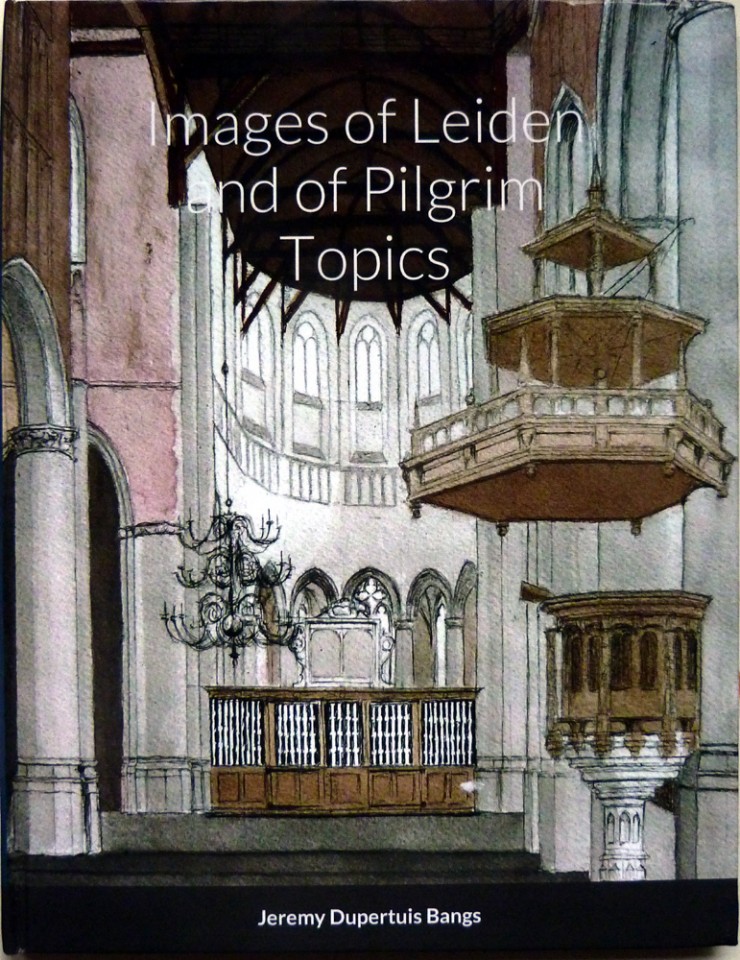 Images of Leiden and of Pilgrim Topics was principally aimed at the large number of visitors we expected to welcome in 2020 to the Leiden American Pilgrim Museum. Many in the past have asked if we had such a picture book about Leiden or the Pilgrims, or both. It was not a year with many visitors, but anyone wanting the book can order it, print-on-demand (printed by Lulu Publishing). My drawings and paintings of Leiden include some pictures of places associated with the Pilgrims, such as Leiden’s city hall, where Pilgrims were married in civil ceremonies; the elaborate entrance to the 1607 Penshal, a market for cheap meats undoubtedly patronized by Pilgrims; and also the Pieterskerk, where the Pilgrims’ minister John Robinson was buried in 1625. Among several pictures of the church is a reconstruction of the view across the churchyard to the Green Close (or Green Gate) where Robinson and other Pilgrims lived. This drawing is contrasted on the same page with a closely similar view as seen in 2012. The Green Close has been replaced by the Jean Pesyns Almshouse from 1683; the free-standing bell tower is seen at the corner of the Kloksteeg (Bell Alley); the upper story of the church porch had not yet been built to house the bellows of the organ, enlarged in 1628-1632; and the churchyard was still a grassy graveyard, unpaved. But the book has other pictures of the Pieterskerk, as well as the Hooglandsekerk and the Marekerk. One unusual depiction is an imaginary reconstruction of the Pieterskerk in pre-Reformation times. Around 1984, I was asked by an Evangelical television program to provide this image, so they could contrast it with what they considered to be a great improvement when all the statues and other Catholic ornaments had been removed. They decided, however, not to use my painting, because they’d expected something less attractive, they said. This was not abhorrent enough. Now I’d probably change the picture a bit. It’s too clean, and one might expect to find some sort of churchy clutter somewhere. My Leiden pictures are not limited to the historic and picturesque, although such subjects dominate my choices. I’ve included a drawing of Leiden’s gasometer, from 1977, since demolished (removal was probably a good idea, since there used to be a fireworks factory not too far away). The Pilgrim-associated pictures outside Leiden show Scrooby’s Church of St. Wilfred, where the Pilgrim movement arose out of discussions of sermons, guided by William Brewster. There are also pictures of Canterbury and Sandwich, connected with Robert Cushman and Moses Fletcher. Drawings of “Mayflower II” made in 1984 and 2011 are augmented by more recent representations of the “Mayflower” and “Fortune” based on 17th-century depictions of ships. Drawings show Pilgrim houses at Plimoth Plantation and their Indian counterparts, while a painting of the Titicut Reserve from 2019 gives an impression of the land of the Massachusetts Indians.
It is a picture book, but I’ve included a six-page section with photos and narrative explaining the research and reasoning behind the design and construction of the pulpit and its enclosure that stood in the new Fort-Meeting House at Plimoth Plantation for around thirty years from 1988. When I asked in 2019 why the pulpit had been removed, I was told the ancient legend I had first heard in 1987 (when I inquired about the previous pulpit for which I’d been asked to design the replacement): the pulpit “was said to have come from some unidentified local church.” The museum’s “historians” were convinced by the intensity of their intuition that the Pilgrims would not have used a pulpit like that. In fact, as these six pages show, that was precisely the sort of pulpit the Pilgrims did use; and its associated furniture doubled quite easily for court sessions. The pulpit and its enclosure were certainly among the most thoroughly researched replicas in the Pilgrim village! But the book does not end there. A final picture shows the interior of Canterbury Cathedral. Why? It’s a nice drawing – one of my best – and I like it. Regarding its relation to the Pilgrims, the cathedral epitomizes all the Separatists hated in the Church of England.
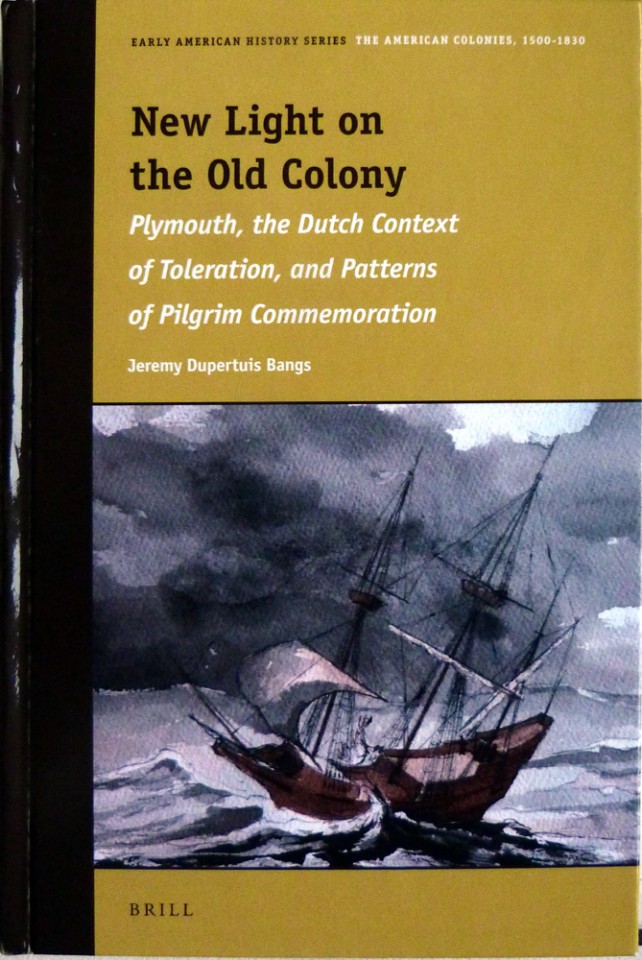 New Light on the Old Colony compiles 15 essays in three topical groups. 2020 seemed to be an appropriate time to put out a 560-page survey of the fruits of my forty years of thinking about the Pilgrims, their world, and the ways they have been remembered, studied, and glorified or, more recently, vilified. The first part – “The Old Colony” – is divided in two sections, about “The Colony” and “The Towns.” The second part is called “The Dutch Context of Toleration,” while the third has four chapters on the theme “Patterns of Pilgrim Commemoration.”
New Light on the Old Colony is published as volume 10 in Brill’s Early American History Series, edited by Jaap Jacobs (University of St. Andrews), L. H. Roper (State University of New York at New Paltz), and Bertrand Van Ruymbeke (Université de Paris VIII – St. Denis and Institut Universitaire de France). It is beautifully produced (including a couple dozen color photos!) and, like other volumes in the series has a price of $ 210, which indicates that the publisher aims its books at university libraries and professional historians, and not the casual reader. The obvious question is, why would I want a book published that way? The answer has to do with promoting the subject of the book – the Pilgrims – for any audience beyond that of “Mayflower” descendants mostly searching for their personal ancestors. I think the history of the Pilgrims and their colony is a subject worth the attention of serious historians; putting this wide-ranging compilation of my Pilgrim research out in a peer-reviewed form gives it a much better chance (although no guarantee) of being reviewed in professional historical journals than if the book had been published by any genealogical society or by the Leiden American Pilgrim Museum. The book, if reviewed, could be seen by historians of 17th-century European colonial expansion and of interaction with New England’s indigenous people. Much prejudice goes against that expectation. The dominant and dismissive opinion among historians is that Plymouth Colony was “insignificant” (as Samuel Eliot Morison said), that it was one of the least important of the colonies – a “backwater” (Darret B. Rutman), and that the Pilgrims themselves were unambitious simple folk whose lives consisted of boring routine and whose pathetic goal was just “to survive and worship in their own fashion” (Richard Middleton). That’s the more positive assessment, which is being replaced recently by a popular image of the Pilgrims as nothing more than bigots significant for oppression of Native Americans. I’d like to present a complex contrary view – not to add to the panegyrical approach beloved of descendants, but to restore the Pilgrims and Plymouth Colony as a topic worth knowing in depth.
New Light on the Old Colony begins with a chapter that surveys the ongoing significance of the Mayflower Compact throughout the existence of Plymouth Colony, then describes the development of the colony’s government, settlement expansion, establishment of new towns and churches, and the colony’s emerging representative democracy. This and the second and fourth chapters are published here for the first time (other chapters have appeared as dispersed journal articles or as introductions to document publications previously). The second chapter focusses on “Tribes and Land Reserves in Plymouth Colony.” Responding to confusion about Native society dominating the 2020 commemoration publicity, I attempt to explain the history of the Pilgrims’ contact with the several tribes who already lived where the Pilgrims came to settle, the Nausets, Pokanokets, and Massachusetts, bringing together information that is spread chronologically (rather than arranged topically) throughout my book Indian Deeds – Land Transactions in Plymouth Colony, 1620-1691 (NEHGS, 2002, rev. ed. 2008).
Chapter 3, “William Bradford’s Sources for Dutch Law: Edward Grimeston and Emanuel van Meteren,” pursues Bradford’s awareness of Dutch law on civil marriage – a practice the Pilgrims introduced into English legal life by adopting it in their colony. Civil marriage, with its necessarily implied separation of church and state, is certainly one of the Pilgrims’ most influential and lasting contributions to future developments in American history. Also examined is the Pilgrims’ familiarity with the Union of Utrecht of 1579. That treaty established the united provinces of the Low Countries (known at the time as the United States) in a form that is reflected in the structure of the United Colonies of New England (1643?) which in turn inspired the 18th-century Articles of Confederation, the first constitution of the United States of America.
“Intellectual Baggage: the Useful Pilgrims and the Culture of Plymouth Colony” is a chapter that surveys characterizations of the Pilgrims used to illustrate or support the once current attitudes of later times, ranging from pious, courageous home-loving national founders to bumbling incompetents dependent for their survival on selfless help from Native Americans they ultimately displaced. A quick overview of the books the colonists owned gives a more nuanced view. (This chapter is my speech from April, 2019, given at Pilgrim Hall Museum. The subject of Pilgrims’ books is examined in more depth in the book, Intellectual Baggage, discussed here next.) The first part of the book concludes with my essay from 1999 identifying a painting from 1620 by Adam Willaerts as an imaginatively condensed composition depicting the departure of the Pilgrims from Delfshaven, pointing to another painting of his that might represent Plymouth Colony, and reproducing a large engraving of The Ratification of the Treaty of Westminster in 1654, where I recognize a portrait of Edward Winslow among the dignitaries depicted as onlookers (which Winslow was, at that event).
Section 2 of the first part of New Light on the Old Colony looks at the towns of Scituate, Eastham, Sandwich, and Marshfield by presenting introductory material from my past volumes that published transcriptions of those towns’ manuscript records from the Plymouth Colony period. Town records’ details of life throughout the colony go beyond the topics covered in the administrative accounts of the colony court on which previous histories of the colony have relied. Sandwich and Marshfield, for example, had to confront specific problems of Quaker insubordination but also voted to establish graduated taxes for the ongoing support of the indigent disabled. Eastham’s records of the earmarks of livestock give clues to shifts in the economy, as well as to equitable treatment of Indians which might have contributed to their remaining as allies of the colonists and not participating in the uprising known as King Philip’s War. Although Scituate’s significance to the colony’s history is overlooked in standard surveys, that town became Plymouth Colony’s largest in the second half of the century, surpassing the town of Plymouth in population and economy, Excerpts from the introductions to my 3-volumes of Scituate Records cover numerous topics and include a discussion of the historiography of “the New England Town” (Lockridge, Demos, Fischer, Powell, Greven).
Combining the material in the chapters of this first part of New Light on the Old Colony, a new and more elaborate idea of Plymouth Colony life emerges, one in which the assumption of bucolic insignificance gives way to an interwoven fabric of geography, material culture, and ideas emerging amidst changing assumptions.
The second, middle part of New Light gives detailed attention to an international relief campaign during the seventeenth century in favor of religious toleration, stimulated by the charitable actions of Dutch Mennonites providing material and polemical aid to persecuted fellow-believers in Switzerland and the Palatinate, some of whom would eventually be among the first colonists of Pennsylvania. The Mennonites enlisted help for their ecumenical approach to toleration from a wide assortment of political and religious leaders. The Pilgrims were in direct contact with early proponents of this relief effort who developed arguments for religious toleration that we see reflected in the writings of Thomas Helwys (a Baptist founder who fled from England with the people who later became the Leiden – Plymouth Pilgrims), Roger Williams (who preached in Plymouth before moving to Rhode Island), William Penn, and John Locke. Tendencies towards toleration in Plymouth Colony, such as James Cudworth’s stirring defense of New England Quakers against persecution, published in London in 1659 (The Secret Workes of a Cruel People Made Manifest), arose in awareness of these efforts to end religious persecution in Europe.
Part 3 of New Light on the Old Colony has four chapters. “Commemorating Colonial New England’s First Families: the Triumph of the Pilgrims” comments on the iconology of 19th- and 20th-century historical paintings and pageantry. 19th- and 20th-century history paintings of the Pilgrims are often criticized for what are considered historically inaccurate anachronisms, such as the log cabin in the background of Jennie Brownscombe’s painting of “The First Thanksgiving.” But their meaning goes beyond the superficial correctness of archaeological detail, or its absence. In this chapter I examine art historical sources to wonder what indicates visually that the people or actions depicted are important and what emphasizes that the Pilgrims were worthy of commemoration. Putting the signing of the Mayflower Compact in a picture that compositionally descends from a Rembrandt group portrait, for example, is one way to imply how important the action depicted must be. Great art must convey great actions – and what could be greater than an unconscious allusion to Rembrandt? Or, why does that huge statue of “Faith” by Hammatt Billings have her finger up in the air? The gesture goes back to Cesare Ripa’s sixteenth-century codification of rhetorical gestures; this represents Eloquence, and we see it again in depictions of John Robinson, Martin Luther, and John Wesley thus placing the Pilgrims’ leader in the ranks of famous Reformation leaders. Even the recurrent costumed parades in Plymouth, Massachusetts, derive their roots – and their meaning – in ancient customs, particularly the Burgundian “Joyeuses Entrées.” Why do the Pilgrim houses at Plimoth Plantation (now calling itself Plimoth Patuxet) keep changing? My chapter “The Hypothetical Nature of Plimoth Plantation’s Architecture” explains the underlying assumptions inspiring the various concepts of Pilgrim society and Pilgrim houses that have come into existence from the 1940s until now. Getting the houses right has been thought to be an essential step towards getting the Pilgrims right.
Chapter 14, “Always More Pilgrim Books” is a quick survey of the major literature about the Pilgrims, after Bradford and Mourt’s Relation, beginning with Nathaniel Morton’s New England’s Memorial (1669) and ending with the note that 2020 would see new books on Pilgrim history by scholars Francis Bremer, James Baker, David Silverman, and John Turner. Books in between are given very brief descriptive comments. This chapter was my after-dinner speech at the Mayflower Society’s triennial banquet in 2011. In 2020, I’ve added comments on some more recent books, by Glen Cheney, Rod Gragg, Jay Milbrandt, Rebecca Fraser, and David Lupher.
The final chapter in New Light on the Old Colony is my dissection of nonsense about the Pilgrims published on the internet: “Thanksgiving on the Net: Roast Bull with Cranberry Sauce.” One after another I present some of the most bizarre mis-statements about the Pilgrims and their colony. Here’s one writer’s view: “the Pilgrims were starving and even went so far to dig up some remains of the Wampanoag people and eat them as a means to survival.” I guess it takes a professional historian to remind readers that William Bradford repeated the second-hand rumor that some Spanish colonists had been reduced to eating “dogs, toads, and dead men,” and that he thankfully let it be known that “From these extremities the Lord in his goodness kept these his people [the Pilgrims], and in their great wants preserved both their lives and healths; let his name have the praise.”
The largest audience for the Pilgrim story, whether books, articles, pictures, or films continues to be composed of descendants who fill the internet with enthusiastic but often unreflective praise for distortions my research compels me to reject. But the wider public only vaguely aware of the Pilgrims was confronted during the 2020 commemorations with a revised story emphasizing the “Mashpee Wampanoags” as the true heroes who saved the Pilgrims as a prelude to having been deprived of their land and culture, or to put it briefly, Indians good and noble, Pilgrims bad and regrettable. Maybe my book’s more complicated view, appearing from a respected academic press, will reach the eyes of a historian or two, eventually leading to a re-assessment, if the subject again achieves much recognition at all.
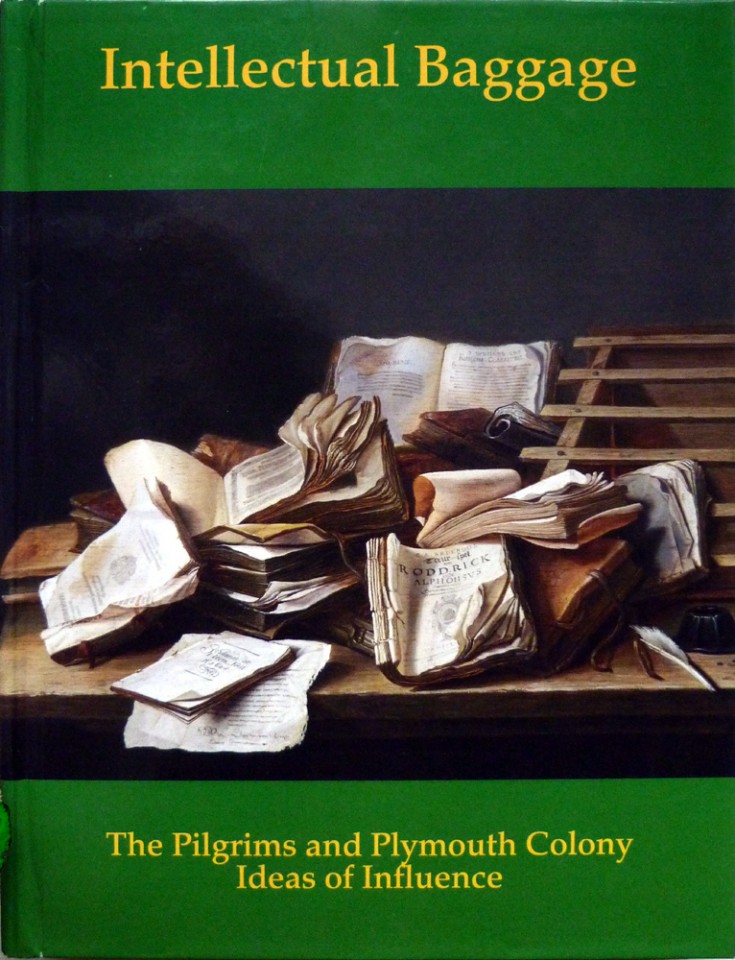 Intellectual Baggage, The Pilgrims and Plymouth Colony, Ideas of Influence – A catalogue of an imagined exhibition, 2020. As a major exhibit I was invited to conceive for Leiden’s municipal museum De Lakenhal, “Intellectual Baggage” would have paid attention to books the Pilgrims owned as an entrance to the world of ideas that gave structure to their understanding of the new circumstances confronting them in Plymouth Colony. Even before the corona-virus, the museum’s director preferred to shift away from the Pilgrims themselves and direct attention to modern problems of immigration, refugees, freedom of religion, and oppression of native peoples – with the Pilgrims as useful props for thinking about today’s events rather than those of four centuries ago. The modern themes were consistent with the international aims of the 400th anniversary activities coordinated by someone from the marketing department of the town of Plymouth in England (which was a brief, unplanned lay-over in the Pilgrims’ emigration from Leiden and London to New England, but which managed to grab control of the commemorations to emphasize the town’s aspirations for future relevance). I decided to publish the catalogue for the imagined exhibit anyway. The catalogue can be valuable, I think, for people who might never have been able to visit the exhibit themselves even had it taken place.
Preceding the catalogue entries, essays introduce Pilgrim-related topics: “Pilgrim and Puritan Religious Ideas” (by Francis J. Bremer), the Pilgrims’ familiarity with classical sources – “Pilgrims and the Classical Heritage” (by David Lupher), the wide-ranging activities of Pilgrim Isaac Allerton and of Plymouth Colony leader Thomas Willett – “Books Defined the life of Isaac Allerton, Founder of American Commerce” and “Start spreadin’ the news – about Pilgrim Thomas Willett, the first mayor of New York City” (two essays by David A. Furlow), and Leiden’s seventeenth-century pictures of books – “Pages in Images. A Study of the Still-Lifes with Books painted in 17th-century Leiden” (by Sarah Moine). My contribution is an introduction (“The Pilgrims – Why Books?”) and an essay about the Pilgrims as publishers during their Leiden exile. These essays expand our understanding of the Pilgrims’ lives beyond the stereotypical assumption of simple rustic domesticity punctuated by single-minded fanaticism. In the introduction, I write, “One aspect of understanding a broader conception of who the Pilgrims were, of what Plymouth Colony was, can be approached by obtaining some familiarity with what they read – the intellectual baggage that colored their understanding and interpretation of the events out of which they emerged and in which they experienced their lives. Many underlying ideas were shared by these people and their contemporaries, or by some of them; and within the framework provided by these presuppositions the Pilgrims attempted to revive a true church whose purity would serve as a beacon to others in the midst of surrounding religious failure.”
The catalogue describes 57 books and pamphlets, most of which appear on the probate inventories of people who died in Plymouth Colony. These follow a repeated form – title, indication of what Pilgrim owned a copy of the book, biographical information about the author, ending with a description of the book’s contents and saliant argumentative points. The entries run from two to six pages, each illustrated with author portrait (where possible), title page, and in numerous cases illustrations from the book catalogued. I wrote most of the entries, but there are several contributions by Sarah Moine (Curator and Assistant Director, Leiden American Pilgrim Museum), Donna Curtin (Director, Pilgrim Hall Museum), and Connor Gaudet (Curator, Pilgrim Hall Museum). The books start with the Bible, followed by church history (Eusebius, Foxe, Clarke), more general history (Camden, Godwyn, Richardson, Grimeston, Bentivoglio), thencontemporary theology (Calvin, Perkins, Arminius, Prynne), exegesis (Vermigli, Baynes, Andrew Willett, Burroughes), polemics (Calderwood, Cartwright, de las Casas, as well as various pamphlets), New England (Smith, Mourt’s Relation, Thomas Morton, Nathaniel Morton), and an assortment of other topics, such as botany (Dodoens), law (Blount), pious and philosophical advice (Teelinck, Downame, Robinson, de la Primaudaye), military tactics (Barriffe), ending with The Book of the General Laws … of New-Plimoth (1671, 1685). To give a taste of the catalogue entries, here’s one that covers two books by William Camden.
[5] William Camden, Britannia; [note 417]
[William Brewster, nr. 60]
[6] William Camden, Remaines Concerning Britaine: [note 418]
[William Brewster, nr. 8]
William Camden (1552-1623) studied at Oxford, taught school in London, was appointed herald (Clerenceau king-of-arms, 1597), and retired in 1618 to Chislehurst. His extensive travels allowed him to collect material for the first topographical and historical survey of the British Isles., Britannia (1586 with later expanded editions), and for an intended history of England, of which only parts were published, including Annales, a detailed history of the reign of Elizabeth I.
Brewster’s books by William Camden survey Britain and British society from several topical points of view. The first volume, Britannia, discusses early references to Britain, especially from Roman authors, then describes the historic peoples of the British Isles – Picts, Scots, Saxons, Danes, and Normans. Camden next covers historic geographical divisions, Kent, Sussex, East Anglia, Wessex, Northumbria, Essex, and Mercia. The division of the English church into the provinces of Canterbury and York is mentioned, followed by a descriptive listing of ranks of society, from the king down to gentlemen, yeomen, and craftsmen or tradesmen. After a brief
explanation of Britain’s various levels of judicial courts, Camden devotes the bulk of his book to chapters about the counties and regions of England, Wales, Scotland, Ireland, and the Isle of Man with other islands, giving a summary of their early history followed by detailed overviews of each, ending by listing the number of parish churches in each region. Besides commenting on the genealogies of local nobles, he illustrates some inscriptions and calls attention to several Romano-British coins.
Brewster could read about his native county, called by the Saxons, Snottingahamscyre, but called by us, says Camden, Nottinghamshire. Besides mentioning the “Shire Wood” (Sherwood Forest), Camden tells about the River Trent, ancient noble families, and the towns of Southwell and Nottingham, as well as the castle at Newark. But Brewster’s native village of Scrooby was too small to attract attention.
Camden’s Remaines begins with a statement of superiority. Britain is “wel known to be the most flourishing and excellent, most renowned and famous isle of the whole world: So rich in commodities, so beautifull in situation, so resplendent in all glorie, that if the most Omnipotent had fashioned the world round like a ring, as he did like a globe, it might have been most worthily the onely gemme therein.” After a brief summary of Britannia’s survey, Camden continues with new topics, mostly aspects of the English language. Before providing etymologies of first names and surnames, he complains about a new fashion for “prophane” names, such as Diana, Cassandra, and Venus, before noting that, “in our late reformation, some of good consideration have brought in Zachary, Malachy, Josias, &c., as better agreeing with our faith, but without contempt of countrie names ...” Vanity, he claims, inspires “the new names, Free-gift, Reformation, Earth, Dust, Ashes, Delivery, More fruit, Tribulation, The Lord is neare, More triall, Discipline, Joy againe, From above; which have lately been given by some to their children with no evil meaning, but upon some singular and precise conceit.” Allusions, rebus, and anagrams are discussed before histories of money and clothing. Camden the herald illustrates coats of arms in explaining “armories.” Exemplary “wise speeches” are published before a long list of proverbs, poems, epigrams, rhymes, and epitaphs. “All is not gold that glisters. … There longs more to wedding than foure bare legs in a bed. … The tide stayeth for no man.”
William Bradford uses the last in his famous description of the Pilgrims’ departure from Delfshaven. Intellectual Baggage, The Pilgrims and Plymouth Colony, Ideas of Influence is the first book to present in such variety the sources of Pilgrim perception. This book opens the reader’s eyes to the Pilgrims’ comprehension of the world.
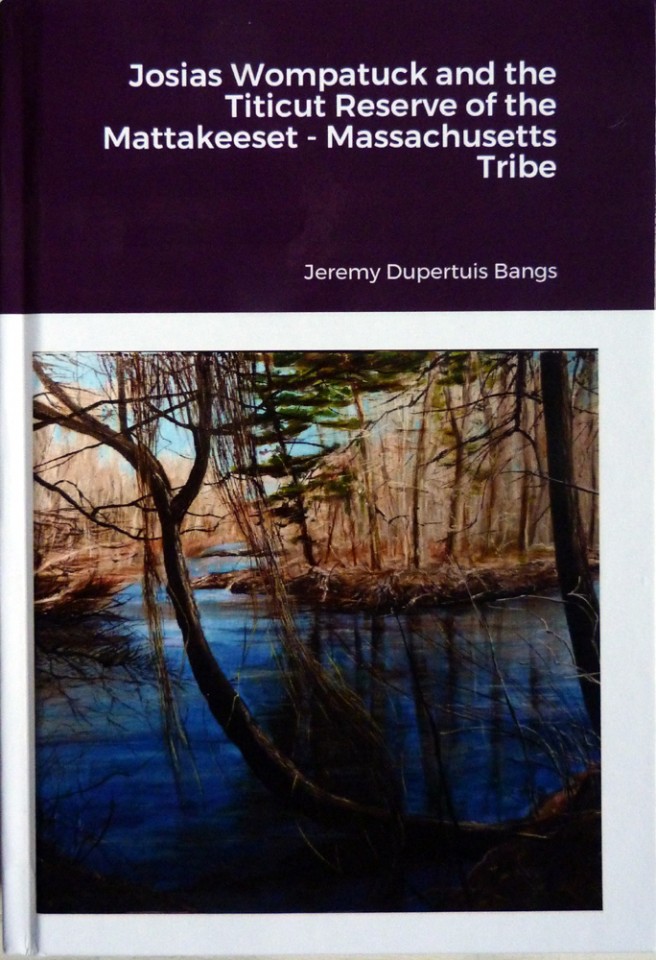 Josias Wompatuck and the Titicut Reserve of the Mattakeeset – Massachusetts Tribe. The 400th anniversary of the arrival of the “Mayflower” turned into a revolving stage on which the Pilgrim story was replaced by the declamatory presentation of an ersatz history of the imagined noble heroism of the Wampanoag tribe. Disregarding the historical record, the Indians are praised for their high-minded social organization that was both matriarchal and democratic, while characterized by a peaceful sharing of resources and land based on ecologically respectful mutuality such as the Pilgrims could never understand. This ideal arrangement was destroyed by the arrival of the Pilgrims whose primary importance in history was the destruction of what had been before. This revised interpretation (“Our Story” according to the Wampanoag “historians” Steven and Paula Peters and Linda Coombs) insists that the idea that the colonists and natives met on friendly terms is an inaccurate myth that distorts the tense reality of the 1621 “first Thanksgiving.” A major polemical point is that it would be only fair and appropriate in the midst of remembering the arrival of the Pilgrims for the government to give the Mashpee Wampanoag tribe control over the Titicut Reserve, which in their new maps lay in the midst of a large Wampanoag imperium that extended from the south coast of Cape Cod all the way to the Merrimac River. The urgency of this discussion of the Titicut Reserve is a consequence of that massive publicity campaign during the last several years by some people from Mashpee who pretend that the Titicut Reserve is (and always has been) “Wampanoag” territory. They have received the sympathetic support of many people wanting to avoid being oppressors of Natives, while at the same time being ignorant of the historical circumstances of the Titicut Reserve and the tendentiousness of the attempted land-grab.
The last of my Plymouth Colony books presents the historical evidence that the Titicut Reserve was established by Josias Wompatuck in the seventeenth century to remain perpetually a possession of the Mattakeeset – Massachusetts Indians and never was a Wampanoag reserve. (As shown on pp. 60-61 of my book Indian Deeds, “Mattakeeset” and “Massachusett” are both transliteration attempts to render the same word phonetically.)
The book’s introduction is followed by “Tribal Territory and the Boundaries between Pokanoket and Massachusetts Property.” The word “Wampanoag” was not commonly used in the time of Plymouth Colony, being a later name for the combined Nauset, Manomet, and some Pokanoket Indians. The deeds by which Indians sold clearly defined parcels of land to the colonists indicate a division between land under Pokanoket control to the west and southwest of Plymouth (town), and land north and northwest, extending into Massachusetts Bay Colony, belonging to the sachems of the Mattakeeset - Massachusetts tribe.
That the argument can be based on detailed land records is itself a contradiction to Paula Peters’ assertion that “For the Wampanoags there was no consideration of owning land.” They “had never drawn boundaries to deed land, and never possessed land or cattle,” she says (on pp. 42-43 of her essay “Of Patuxet” in the introductory material to the 400th Anniversary Edition [of William Bradford’s] Of Plimoth Plantation). Of course, at a literal level it is true that the boundaries were not “drawn”; instead, the boundaries were determined by natural features, such as rivers or rocks identified as boundary points. Parcels of land, so identified, had descended personally according to patriarchal principles, generation to generation, as sometimes cited in court during disputes among Indians as to who the rightful owner was with authority to sell the land to the colony.
“Massachusetts Land” is summarily described, then the details are examined, of transactions by which Sachems named Josias Wompatuck (three generations with the same name) sold land, to identify “Land Excepted and Usufruct Retained.” In numerous sales of land by Massachusetts sachems to colonists, the Indians reserved rights to fish or hunt, to fell trees, or cut rushes on the land. In other transactions large areas were sold but within the defined greater acreage smaller portions were reserved and not sold, such as “ten acres upon the hill where James and Thomas the Indians now plant as alsoe another hill Reserved for a burying place for the Indians with libertie of fier woods from of[f] the Comons and free libertie for fishing for the Basse or Eeles together with the English and free libertie and access to the weire for herrings for theire use in the season therof.”
The specific documentation about the Titicut Reserve occupies the next section, with summaries of each archival reference from the establishment in 1664 into the early 18th century. Josias Wompatuck granted the Titicut Reserve to Peter Pomponoho and Thomas Hunter Waweeus under a restrictive covenant guaranteeing the land would remain forever in the possession of Indians. Peter, as well as his heirs and assigns, were “absolutely” forbidden and prohibited “from giving selling or any maner of way making over or conveighing the said lands or any part or parcell therof unto the English for ever.” If Peter or any others “at any time hereafter attempt to give sell or any way make over any part or parcell of the said lands unto the English, he or they that shall so doe shall by vertue of this prohibition forfeit and loose all his and their Interest in the said lands and by vertue of this deed the said lands lost or forfeited shall hall to and belong to the rest of the then titecut Indians and their Indian heirs and Assigns for ever.” As I indicate on pp. 38-39 (and had also had stated in 2002 in Indian Deeds and again in New Light on the Old Colony), the conveyance is registered in Plymouth Colony’s court records; the legal force of this stipulation in a deed from one Indian to other Indians must be derived, however, from Native legal practice (as recognized by both the giver and recipients).
After King Philip’s War (1675-1676), documents from 1678, 1685, 1686, 1689, 1695, and 1697/98 indicate that the terms of the establishment of the Titicut Reserve were respected and confirmed by the court (because the Massachusetts Indians were not part of King Philip’s uprising of Pokanoket Indians allied with Narragansetts and Nipmuks). All forty-nine 17thcentury documents concerning the Titicut Reserve are published in full on pp. 88-176.
Four sections of the book consider the background of the modern disputes and Wampanoag claims. “Oral History and the Creation of Myth at Plimoth Plantation” (pp. 57-60) and “W.I.P. Episodes (pp. 60-87) include my recollections of peculiarities of the Wampanoag Indian (or Indigenous) Program at Plimoth Plantation from the time when I was Chief Curator there, and of Nanepashemat (Anthony Pollard), whose remarkable self-creation as an Indian sage depended heavily on his diligent reading of back issues of publications from the U.S. Bureau of Indian Affairs and of the books of Carlos Castaneda. Recalling the wisdom of Grey Owl (Archibald Belaney) in the 1930s, Nanepashemet’s oracular pronouncements in the 1980s and early 1990s formed the basis for Plimoth Plantation’s new Wampanoag history that replaces documented description with sentimental romanticism such as described by Steven Peters, who fantasized “mostly an idyllic way of life for my ancestors prior to the Europeans coming over.” (quoted on p. 87).
A fascinating aspect of modern inter-tribal rivalry is the feuding about who’s the real Indian; and that affects the question of recognizing groups of descendants of Indians as bands or tribes. The first edition of this book ended with an appendix (pp. 177-180) examining “The Inherent Racism of Public Records.” When 19th- and 20th-century records, such as census lists, are used to determine whether or not someone is, was, or should be considered an “Indian,” two or three levels of inherent racism confuse the research. First, most such records have a category for race or color where the person filling out the form is instructed to enter any alternative to “white,” but the possible answers are restricted to “black,” or “mulatto,” or sometimes “colored” or “mixed.” Only rarely is “Indian” indicated as a possibility. Second, the determination of “race” or “color” is individual and idiosyncratic because the decision simply reflects the personal opinion of the recorder and had no necessary reference to the self-identification of the person recorded, or with the mutual group identification among that person’s acquaintances. An example is given where various government records use the terms “Neg” (for Negro), “In” (for Indian), “M” (for Mulatto) as well as the word “colored” – all for the same people of the same family. These variable terms mean no more than that the external recorders decided that the people they saw didn’t look light-skinned enough to be what the recorder thought a “white” person should look like. But in this case there is documented self-identification as “Indian” and the same identification used by one of the registrars, as well. “M” for mulatto was evidently used when someone wasn’t as light-skinned as would fit the recorder’s idea of “white” nor as dark-skinned as would fit the recorder’s idea of “black.” It might often be an alternative to “Indian.”
Responding to readers’ questions, however, I have added to the book. The second edition of Josias Wompatuck and the Titicut Reserve has been expanded with an Addendum (pp. 181- 224), “Mashpee’s Assertions.” Here I analyze the historical arguments in the submission from 2012 by which the Mashpee Wampanoag asserted their historical hegemony over all other southeast Massachusetts tribes and their claims to ownership of the Titicut Reserve because of a claimed continuity with the Pokanoket Indians. As I write (p, 216), the first sentence of the first chapter of the Mashpee submission for claiming ownership of the Titicut Reserve is this: “The Mashpee Wampanoag are the descendants of the historic Pokanocket/Wampanoag nation.” To that I respond, “No – they are not.”
Not only are the Mashpee Wampanoag not the sole and official continuation of the Pokanoket Indians, the Titicut Reserve was established for a separate tribe, the Massachusetts under Josias Wompatuck. I pay attention to the Mashpee trick of trying to ignore the Massachusetts as a separate tribe, which includes asserting that “historians are agreed that Chickataubut [another name for Josias Wompatuck] was likely acting as an agent for the colonists of Massachusetts Bay in making these claims [to dominion over territories to the south of Massachusetts Bay], and at times Josias’s grants post-date purchases already made from Ousameequin and his heirs.” I’m a historian, and, having just documented the recognition by
Wompatuck’s Indian contemporaries of his possession of land extending from Duxbury to Titicut and the head of the Charles River, I find no basis for the claim that Wompatuck was merely acting in the interests of Massachusetts Bay colonists. Wompatuck’s recognition that Osamequen had possessed land sold in 1645 to colonists is seen when Wompatuck confirmed that sale in 1686, when Osamequen and his sons Wamsutta and Metacom were dead. Wompatuck simply confirmed that the 1645 sale had taken place; the court was attempting to consolidate its title to land in the face of growing sentiment in London to invalidate New England land titles and declare the property to revert to the crown (for eventual redistribution).
Why bother with these details? The 400th anniversary of the arrival of the Pilgrims has been used as a starting point for talk about modern problems of refugees and the oppression of native peoples in other places at other times, but largely to ignore the Pilgrims and to promote false propaganda of idealized, static Wampanoag society that serves to bolster the Mashpee illegitimate attempt to grab the Titicut Reserve away from its historically proper trustees, the Mattakeeset – Massachusetts Tribe, so that Mashpee can build a casino there. Historical lies are presented in a travelling exhibit that seems to enjoy the official support of the institutions where it has been shown – Plimoth Plantation, Pilgrim Hall Museum, The New England Historic Genealogical Society, and the Pilgrim Monument and Provincetown Museum. I can at least offer my usual response – well-documented dissent.


